Dangerous Tree Signs: What to Check Before Storm Season
How to spot a dangerous tree from the ground: lean, cracks, root movement, hanging branches and decay. Plus storm-season prep, what not to do and when to call.
Sam · Owner & Local Tree Care Lead
Updated 05 Oct 2026 · 7 min read
Key Takeaways
- 01Recent change matters most: new lean, fresh cracks, lifted soil, hangers and decay at the base
- 02NSW SES describes storm season as September to April, but major storms can happen any time
- 03Avoid rough topping; Council requires pruning to follow AS 4373
- 04Leave anything within 3 metres of power lines to accredited workers
On this page
Sections
The Short Answer
A tree needs a professional look when something has changed: a new lean, fresh cracks, soil lifting at the base, large dead or hanging branches, or damage after a storm. You can check most of these safely from the ground in about 15 minutes. The best time to do it is before storm season, which NSW SES describes as September to April, but major storms can happen at any time of year.
Warning Signs to Look For
One odd feature on its own does not make a tree dangerous. What matters most is change, and where the tree would land if part of it failed.
A new or increasing lean
Many trees grow with a lean and stay stable for decades. A lean that has appeared recently, or got worse after wind or heavy rain, is different. Look at the ground on the opposite side of the lean for cracks or a raised mound.
Cracks and splits
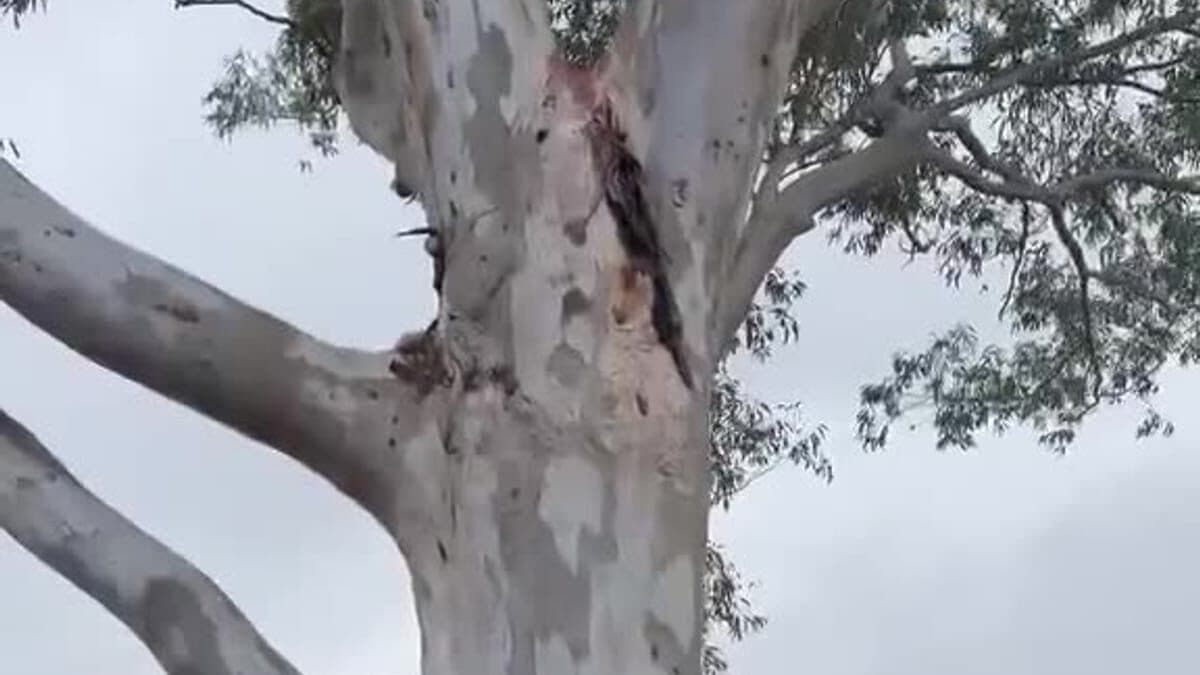
Look for fresh cracks in the trunk, splits where two large stems join, and bark that has split open along a branch. Pale, fresh wood showing in a crack usually means the damage is recent.
Root and soil movement
Soil that has heaved, cracked or lifted on one side of the base can mean the root plate is moving. This matters most after long periods of rain, when soil is soft.
Dead, broken or hanging branches
Dead branches have no leaves when the rest of the tree does, bark falling away, or a brittle grey look. A broken branch caught in the canopy (sometimes called a hanger) can fall at any time, especially in wind.
Decay at the base or trunk
Mushrooms or bracket fungi on the trunk or roots, hollow sounds, cavities, oozing or soft wood can all point to decay inside. Some decay is not serious; some is. It needs a closer look to tell the difference.
Sudden canopy decline
Leaves thinning, browning or wilting across the tree over a short period, when nearby trees look fine, can point to root damage or another problem below ground.
How Urgent Is It?
| What you see | What to do |
|---|---|
| Tree or large branch actively moving, cracking or on a building; wires involved | Keep everyone away and call for help now (see below) |
| Hanging branch over a path, roof, driveway or play area | Close off the area underneath and arrange prompt attention |
| New lean, fresh crack, lifted soil, fungi at the base | Arrange an inspection soon |
| Light deadwood, a branch rubbing a gutter, slow canopy growth over the roof | Plan routine pruning |
For immediate danger, call Triple Zero (000) if life is at risk, NSW SES on 132 500 for storm help, and Ausgrid on 13 13 88 if power lines are involved. Our guide to what to do when a tree falls covers this step by step.
A 15-Minute Check From the Ground
Do this on a calm, dry day, never during wind or lightning.
- Walk all the way around each large tree. Stay outside the area under any damaged branches.
- Look at the base first. Check for cracked or lifted soil, fungi, cavities and damaged roots.
- Follow the trunk up. Note any cracks, splits, wounds or a change in angle.
- Scan the canopy with binoculars or a phone zoom. Look for dead limbs, hangers and broken branches.
- Note what is underneath. Bedrooms, living areas, the driveway, the pool, play areas, the neighbour's roof and power lines.
- Take photos from the same spots each time. Comparing them next season makes slow changes easy to see.
Getting Ready for Storm Season
NSW SES's storm season advice includes trimming trees and branches that could fall on your home, cleaning gutters, downpipes and drains, securing loose outdoor items and checking that your insurance is current.
For trees, that means dealing with the specific branches that worry you, not stripping the canopy. Useful storm preparation can include:
- Removing dead, broken and hanging branches
- Dealing with split limbs or weak unions identified at inspection
- Selectively reducing a branch that is heavy and growing over the roof
- Clearing branches back from gutters and the roofline
- Checking palms for loose dead fronds and heavy seed pods
If you can, move cars out from under branches that worried you at inspection when a severe weather warning is issued.
During and after a storm
NSW SES says the safest place during a storm is inside, away from windows. If you are driving, find shelter away from trees and power lines. Do not go out to check trees during wind or lightning.
Afterwards, walk the property only when conditions have settled, and look up before you walk under anything. Stay well clear of fallen trees and power lines, and do not try to remove trees or branches that have come down on wires.
What Not to Do
Do not top the tree
Cutting a tree back to stubs, known as topping, is often sold as storm-proofing. It can leave a tree stressed, unbalanced and prone to weak regrowth. Northern Beaches Council lists requests for topping among the work it will not approve, and requires pruning to follow AS 4373 (Pruning of amenity trees). Without a permit, Council allows reasonable pruning of up to 10 per cent of a tree's canopy in 12 months, plus deadwood removal. Removing more than that, or removing the tree, may need a permit. Where a tree genuinely needs to be smaller, controlled reduction with planned cuts is the alternative.
Do not climb, pull or cut loaded branches
A split or hanging branch is often held under tension and can spring or twist when cut. The SafeWork NSW Tree works Code of practice, which commenced in March 2026, describes portable ladders as a significant risk for tree work. That is guidance written for workplaces, but the hazards are the same in a backyard.
Do not prune near power lines
The same code says a person without the right training should not climb a tree within 3 metres of electric lines or cut branches that might come within 3 metres during the work. Ausgrid says any tree trimming within 3 metres of its powerlines must only be done by accredited workers.
Trees Near Power Lines
Ausgrid's tree trimming responsibilities page says property owners are responsible for keeping private overhead powerlines, including the service wire to the house, clear of vegetation up to the property boundary. Ausgrid manages vegetation around network lines that are not on private property.
Our team members are authorised for work near live electrical infrastructure, and we assess the clearance and controls needed before recommending any work. You can see the kind of planning involved in our Cromer removal close to wires and a home.
When Council Rules Apply
Council's private-land tree page lists exemptions that often come up with risky trees, including:
- Dead trees not needed as native animal habitat (photos recommended)
- Trees that have fallen or partly fallen in a storm and still present a danger (photos required)
- Trees certified in writing by an AQF Level 5 arborist (or equivalent) as an imminent danger and high risk to life and property, with a copy sent to Council
- Trees within 2 metres of an existing approved building
A tree that is worrying but not dead, fallen or an imminent danger usually goes through Council's permit process. Council lists "removing hazardous trees" among the reasons it may approve removal, and may ask for a qualified arborist report. If Council has asked for a report, our basic, Council-ready arborist reports may suit, and the tree permit guide explains the process. The owner lodges the application; we do not deal with Council on your behalf.
Pruning or Removal?
Most warning signs do not mean the tree has to come down. A single dead limb or a heavy branch over the roof is usually a pruning job. Removal is more likely when the whole tree is dead, badly damaged, unstable at the roots, or simply too big for the space it is in. Where a tree cannot reasonably be kept, our tree removal service takes it down in controlled sections where space is tight.
The point of an inspection is to find the actual problem before choosing the work.
What to Send When You Enquire
- The property address
- What changed and when you first noticed it
- Photos of the whole tree, the trunk, the base and the problem area
- Photos showing what is underneath: roofs, wires, driveways, neighbouring property
- Access details, such as side gates, stairs and slopes
- Any Council letter, permit or report request
How We Can Help
We provide a free on-site assessment and a written quote, with no travel surcharge across the 47 Northern Beaches suburbs we cover. Team members include AQF Level 3 and AQF Level 5 qualified arborists, and we will tell you plainly whether the tree needs pruning, removal or simply watching. If a tree or branch is already failing, call 0425 350 004 at any hour. We aim to respond within two hours.
Frequently Asked Questions
A new or worsening lean, fresh cracks or splits, soil lifting around the base, large dead or hanging branches, fungi at the base and recent storm damage should be assessed promptly, especially near a house or busy area.
NSW SES describes storm season as September to April, but major storms can happen at any time of year. SES's storm season page lists practical preparation steps.
No. Topping can leave a tree stressed and prone to weak regrowth, Council will not approve topping requests, and pruning must follow AS 4373. Targeted pruning of dead, split or overhanging branches is the better approach.
No. Pruning often solves a single dead limb or heavy branch. Removal is more likely when the whole tree is dead, badly damaged, unstable at the roots or too large for its space.
Ausgrid says property owners are responsible for keeping the service wire and private overhead lines clear up to the property boundary. Trimming within 3 metres of Ausgrid powerlines must only be done by accredited workers.
Tree services across the Northern Beaches
Find tree services in your suburb:
Share this article
About the author
Sam
Owner & Local Tree Care Lead
Sam owns and leads Affordable Tree Services Northern Beaches. He is the main point of contact for many customers and coordinates the right team, equipment and next steps for each job.
On this page